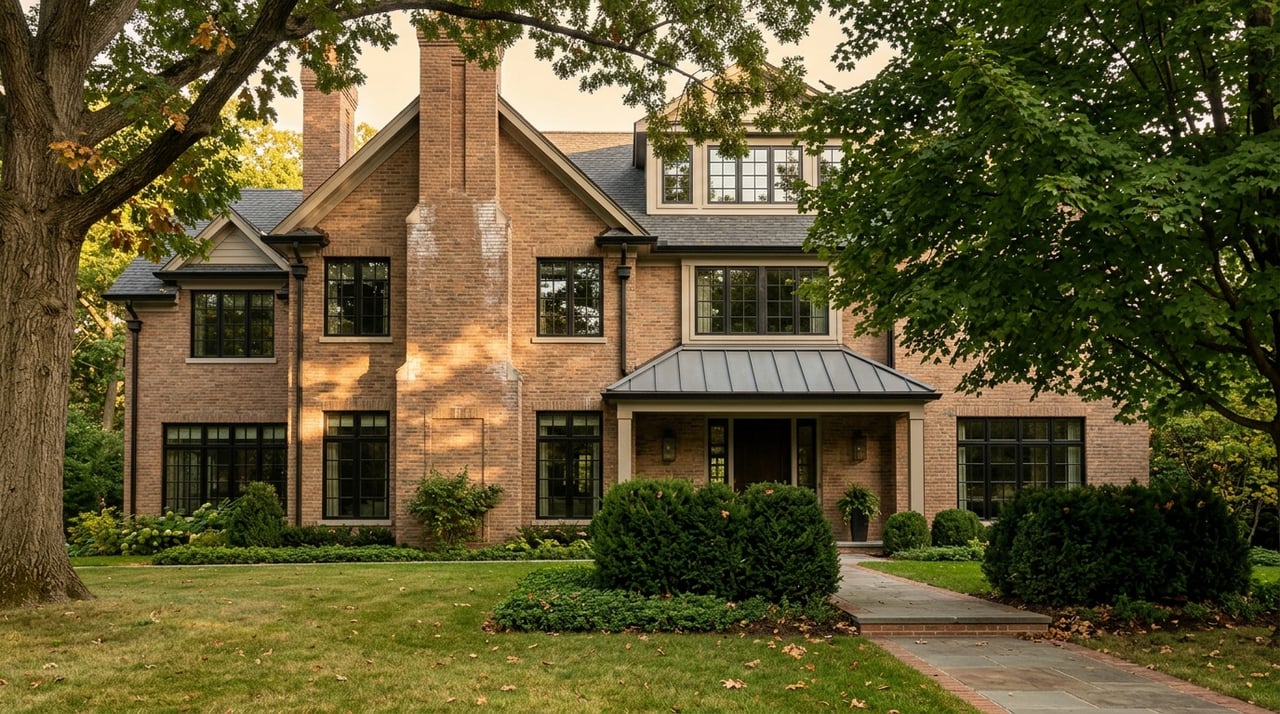
Pull up Bloomfield Hills on five different real estate sites this month and you will get five different answers to what sounds like a simple question. One shows an average home value in the mid-$600,000s. Another lists a median for homes currently for sale at $769,000. A market dashboard pulling from local MLS data puts one specific subdivision at $1.199 million. A luxury listing aggregator puts the average closer to $1.6 million.
None of these numbers is wrong. That is the part most explanations skip. The spread is not a data quality problem. It is the market telling you something true about itself, and the buyers and sellers who understand why will make better decisions than the ones who anchor on whichever number they saw first.
The Numbers Actually Say This
As of August 2026, Movoto listed the median price for homes for sale in Bloomfield Hills at $769,000, working out to $233 per square foot. Zillow's estimate of average home value, posted in late June 2026, sat at $655,975. A local market dashboard drawing on Realtor.com data from May 2026 showed Bloomfield Village, a specific subdivision within the broader Bloomfield Hills market, with a median listing price of $1.199 million and 34 days on market. Two ZIP codes inside the same city told an even sharper story that same month: 48301 carried a median of $1.1525 million with homes moving in 23 days, while 48302 sat at $972,450 with 27 days on market.
Zoom into the active luxury segment and the number climbs again. A search of luxury listings currently on the market puts the median listing price at $1.6 million, with homes averaging 48 days on market and drawing about five offers each. A global luxury aggregator's current inventory shows an average listing price of $1,596,400, ranging from $600,000 up to $8.85 million.
Line those up and you get a spread of nearly $950,000 between the lowest and highest figures, all describing the same city at roughly the same time. If you searched "Bloomfield Hills median home price" and took the first number you found, you could be off by a factor of two before you ever toured a house.
The Market Isn't One Number. It's Four Layers Stacked on Top of Each Other
The reason the medians disagree is that Bloomfield Hills isn't a single price tier wearing one zip code. It's several distinct buyer pools occupying the same municipal boundary, each with its own supply, its own pace, and its own comparable sales.
At the entry point, properties on the edges of Bloomfield Township start around $800,000. These are the homes most likely to show up when a broad average pulls in every transaction, which is part of why Zillow's blended average value lands lower than the listing medians further up the ladder.
One step up sit the established, walkable enclaves: the Cranbrook Triangle and the gated Rudgate community, where pricing generally runs $1.2 million to $3 million. These are the homes that define what most buyers picture when they say "Bloomfield Hills": mature lots, architectural pedigree, proximity to the Cranbrook Educational Community's campus.
Above that, the Vaughn Road corridor properties push into $2 million to $10 million-plus territory, with lots starting at two acres and larger. This is where the market's true trophy inventory lives, and it behaves nothing like the entry tier in terms of days on market or negotiation dynamics.
And then there's a layer that barely touches public data at all. Homes with five or more acres and genuine architectural pedigree have no practical ceiling, and a meaningful share of transactions at the $3 million-plus level happen off-market entirely. Sellers at that tier routinely prefer private sales to protect their privacy, which means the most expensive homes in the city are systematically underrepresented in any median pulled from public listing data. Every algorithm scraping MLS activity is, by definition, missing some of the biggest sales in town.
What a $180,000 ZIP Code Gap Actually Means
The 48301 versus 48302 split from May 2026 is worth sitting with, because it shows the layering effect at a scale a buyer can actually use. Two ZIP codes, both inside Bloomfield Hills, both drawing from the same school system and the same general commute times to Detroit and Birmingham, and one carries a median $180,000 higher than the other, with faster days on market to match.
That gap isn't noise. It reflects which enclaves each ZIP code contains, how much of its inventory sits in the Cranbrook Triangle price band versus the entry tier, and how much of its recent sales volume came from move-up buyers versus first-time luxury entrants. A buyer comparing "Bloomfield Hills" against Birmingham or Franklin as a single line item is comparing an average of averages against those other cities' own layered markets. The comparison that actually matters happens one enclave at a time.
A Recent Listing Shows Where the Ceiling Sits
In April 2026, a 1953-built estate at 1379 N. Cranbrook Road came to market at $4.025 million after a 2024 remodel. The property spans more than 6,500 square feet with five bedrooms, five full bathrooms, and three partial baths, sitting on 1.1 acres in the middle of Bloomfield Hills Village. The listing agent told The Detroit News that homes of that character rarely come up for sale in this community, and that the larger, more estate-like properties here simply aren't cookie-cutter inventory.
That single listing illustrates the layering problem in miniature. A home like this will never be "average" in any blended statistic, because there is no comparable volume of similar sales to smooth it into a median. It sits in its own tier, priced against a handful of true peers rather than against the broader city number, which is exactly why relying on a single citywide figure would tell a buyer or seller almost nothing useful about what a home like this is actually worth.
What This Means If You're Comparing Bloomfield Hills to Birmingham or Franklin
If you're weighing Bloomfield Hills against Birmingham's downtown walkability or Franklin's smaller-town feel, the practical move is to stop comparing city-level medians and start comparing enclave to enclave. A few ways to do that without getting misled:
- Ask which submarket a "median" figure is actually drawing from. A citywide average blends starter properties on the township edges with Vaughn Road estates, which flattens both into a number that describes neither well.
- Weigh listing price against sold price separately. Days on market and offer counts differ meaningfully between the entry tier and the luxury segment, so a "hot market" claim needs a tier attached to mean anything.
- Remember that the top of the market is partially invisible. If you're shopping above $3 million, some of your best comparables may never have hit a public database at all, which is where a local advisor with construction and enclave-level knowledge earns their keep.
- Treat proximity claims literally. Bloomfield Hills sits roughly ten minutes from downtown Birmingham's restaurants and shopping by car, which matters more for day-to-day life than any single price statistic.
None of this means the median is useless. It means the median is a starting question, not a final answer, and the buyers who ask "which Bloomfield Hills are we actually talking about" before they fall in love with a number end up with a much clearer picture of what their budget actually buys.
Frequently Asked Questions
Why do Zillow, Redfin, and Movoto show such different numbers for the same city? Each site measures something different. Some report average estimated value across all homes, others report the median of homes currently listed, and others report median sold price over a trailing window. In a layered market like Bloomfield Hills, those methodologies can diverge by hundreds of thousands of dollars depending on which submarket happens to be most active when the data is pulled.
Does this same layering apply to Bloomfield Township, not just the city of Bloomfield Hills? Yes. Bloomfield Township sits adjacent to and is often grouped with Bloomfield Hills in casual conversation, and it shows the same pattern of entry-level activity near the edges alongside established, higher-priced pockets closer to the Cranbrook area.
If public medians are unreliable at the top of the market, how do I get an accurate read on a specific property or enclave? The most reliable approach is a direct comparison against recently closed sales in that specific enclave, cross-checked against current inventory in the same price band, which is the kind of research a local advisor can pull together faster and more accurately than any single portal's headline number.
Understanding which Bloomfield Hills you're actually shopping in, whether that's a starter property near the township edge or a Vaughn Road estate with acreage to match, changes how you should read every number you encounter next. If you want a clear read on what a specific enclave or property is really worth in today's market, Nicolas Petrucci Properties offers a complimentary home valuation built on current local comparables, not a blended citywide average.